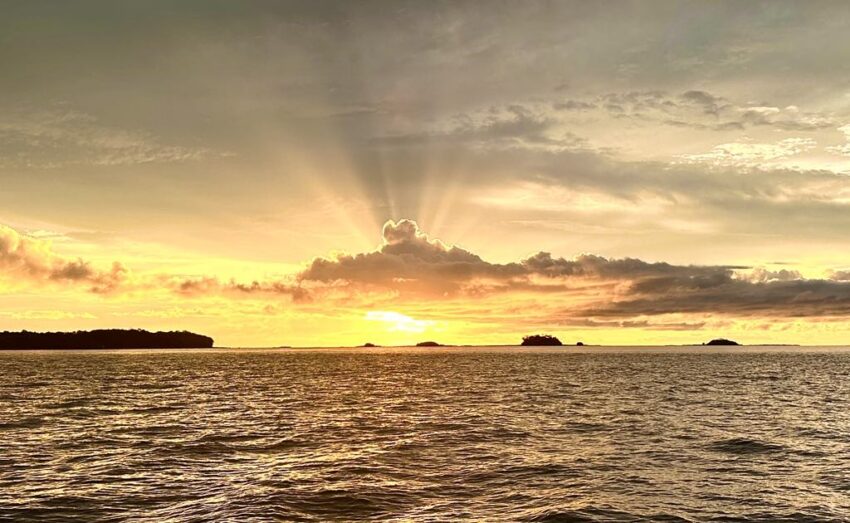
Sometimes, there can be beauty in despair, silver linings in misfortunes, and blue skies in the future where there seems to be nothing but storms.
A Confounding Time in Panama
In our seven years of circumnavigating, I have to say that our time in Panama has been the most confounding. She beat us up, spit us out, and made us question our sanity. While the country itself is nice enough, is very Americanized, and has its quaint aspects, if I never see Panama again… it will be too soon.
It took us three attempts to begin our Pacific Crossing. The first attempt, we had engine issues. The second attempt, we had medical issues and our freezer died. The third time was the charm—at least we thought we were on our way to the French Polynesians, but God had other plans for us. But before I get to those details, I have to rewind to crossing number two… it’s a story that must be told.
The Great Fishing Fiasco
Second attempt, we spent two weeks hanging out around the outer islands waiting for wind to cross. Meanwhile, we were using up the food for our passage. There were no grocery stores on these remote islands. Then, a hint of wind arrived, not great, but we thought we would try to leave anyway. That’s when The Great Fishing Fiasco occurred.
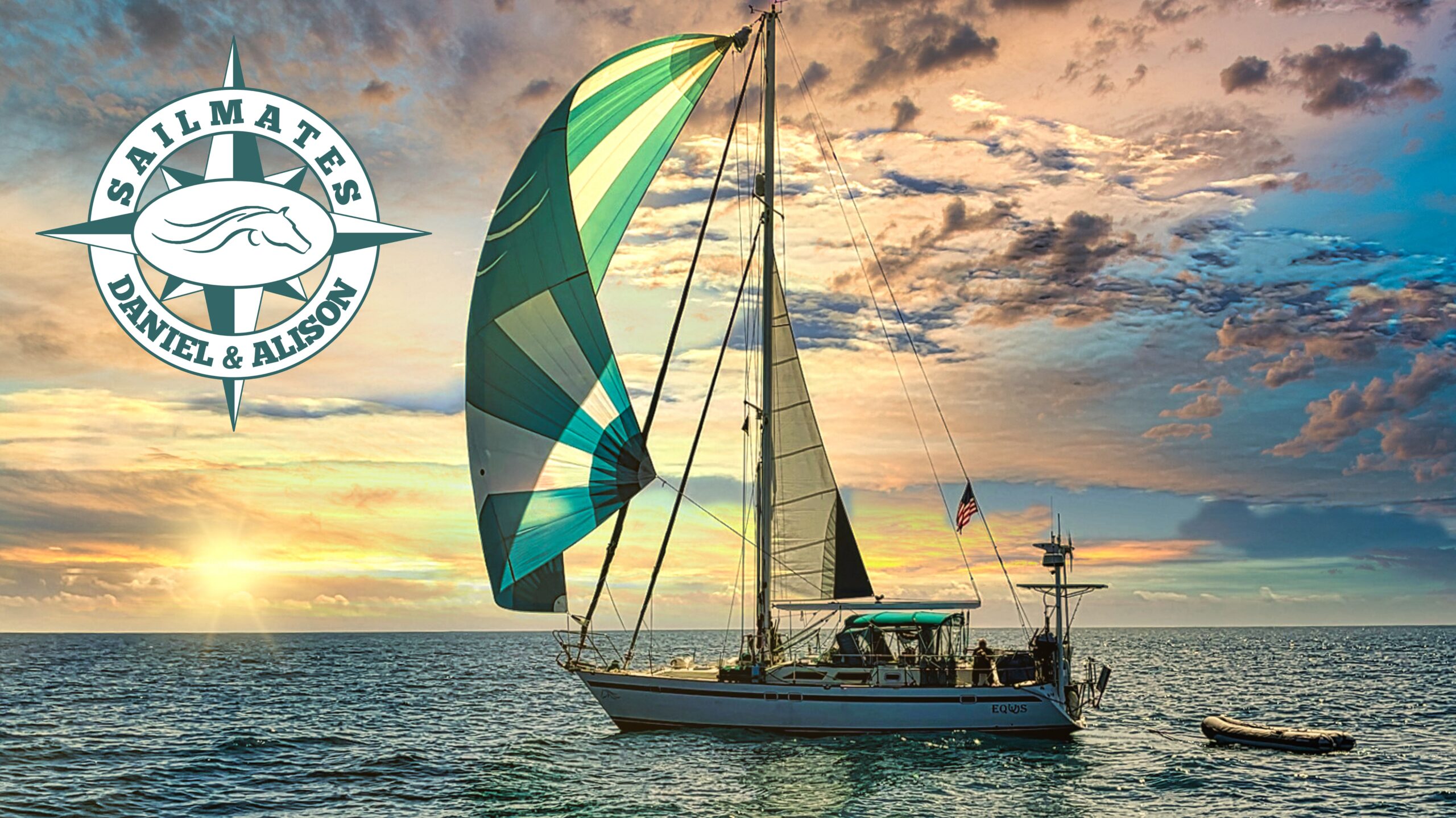
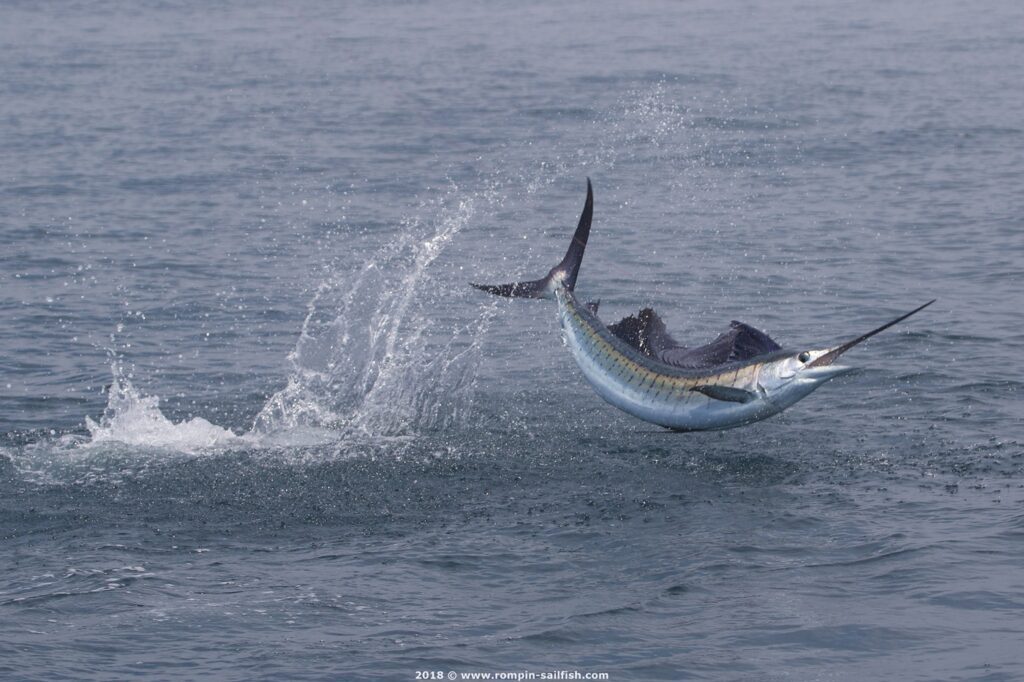
It was a beautiful day, we were heading out with high hopes that we would be successful in beginning our crossing. We were going downwind, not a lot of breeze, so we put up our trusty spinnaker. I decided to put out our fishing line in the hopes of having fresh fish for dinner. After I put out the line, I was gazing across the beautiful vista of the ocean, when I saw a massive fish leap clear into air about a half a mile away. It was gigantic, had a fin and a sword. It was the first time I had ever seen anything like it.
“Wow!” I yelled to Dan. “I think I just saw a sailfish or a marlin or one of those big fish. It leapt clear out of the water. I hope we don’t catch something that big,” I said with a laugh. I wasn’t really worried. The fish was a long way from our boat, and we had a tiny lure out.
Thirty minutes later… the sound of the fishing reel screaming burst the silence. I was closest, so I tried to grab the pole. The rod was bent so hard and the line running so fast, I couldn’t stop it or pick it up. I yelled for Dan, who was already on his way.
Chaos ensued as Dan was unsuccessful in stopping the runaway line. He forged forward and loosened the spinnaker lines to slow us down. We were slowed to almost a stop, but the line and sail were flapping noisily, potentially dangerously. Precious minutes passed as the fishing line was nearing its end. Dan could not make a dent in stopping it.
Then, I had an idea. I grabbed our fishing towel and wrapped it around the pole. “Grab it, with both hands!” I shouted to Dan. Both of us wrapped our hands around the rod and line. A pregnant moment passed… the line stopped feeding out. We looked down, and there was no clear fishing line left. We had reached the bitter end, the black leader before all the line was gone.
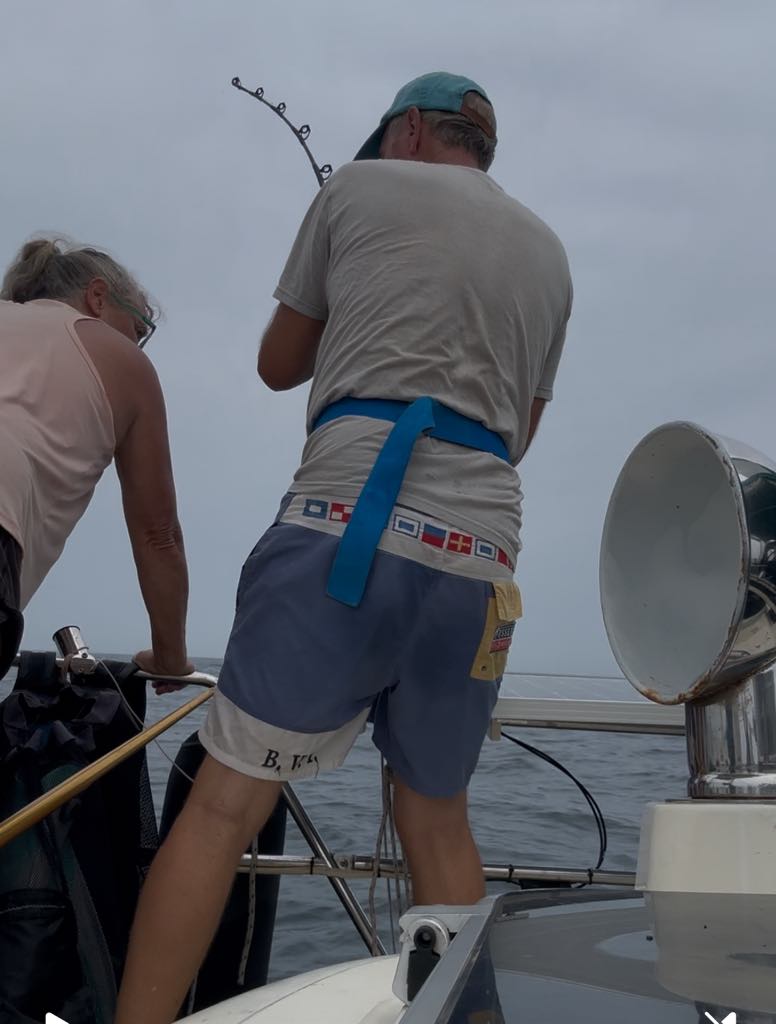
We sat there for a minute; the fish seemed to have tired. We needed a strategy. Dan lifted the rod up, dropped it back down, then reeled in a few inches. It was hard, but he made a little bit of progress. We repeated this until Dan was exhausted. We switched places, and I reeled, but I didn’t last long. It took us an hour, taking turns reeling in a few inches at a time, to make any headway. A few times, the fish made some escape attempts, and we had to grab the towel and hold on with all our might not to lose the precious ground we had gained.
Finally, we saw a huge shadow approach the boat. The fish was, in fact, a huge species of fish with the sail and the spear. It was at least six feet long, weighed hundreds of pounds, and there was no way we wanted to, or could, get that fish on our boat.
The poor guy was as tuckered out as we were. We had no idea how we were going to get the lure out of the fish’s mouth. We could clearly see the pink squid dangling from its beak. We were too high on the deck of the boat to reach down into the water. Then Dan had a really bad idea.
“I’m going to lower the dinghy, get in, and then I can reach the lure.”
The problem with that was that our dinghy was up on davits. We had to keep the fish on the line, lower the boat, and I didn’t like the idea, as one slip would put Dan in the ocean with the fish. Despite my protests, he mostly lowered the dinghy and climbed in.
Two things went wrong immediately. First, the dinghy started tipping dangerously as all his weight was on the outside; second, the plug wasn’t in, and the dinghy would fill with water if it was lowered any further. I went several shades of white as we hauled Dan back in the boat, got the dinghy back up, and held onto the fish, who was now rolling his eyes at our stupidity.
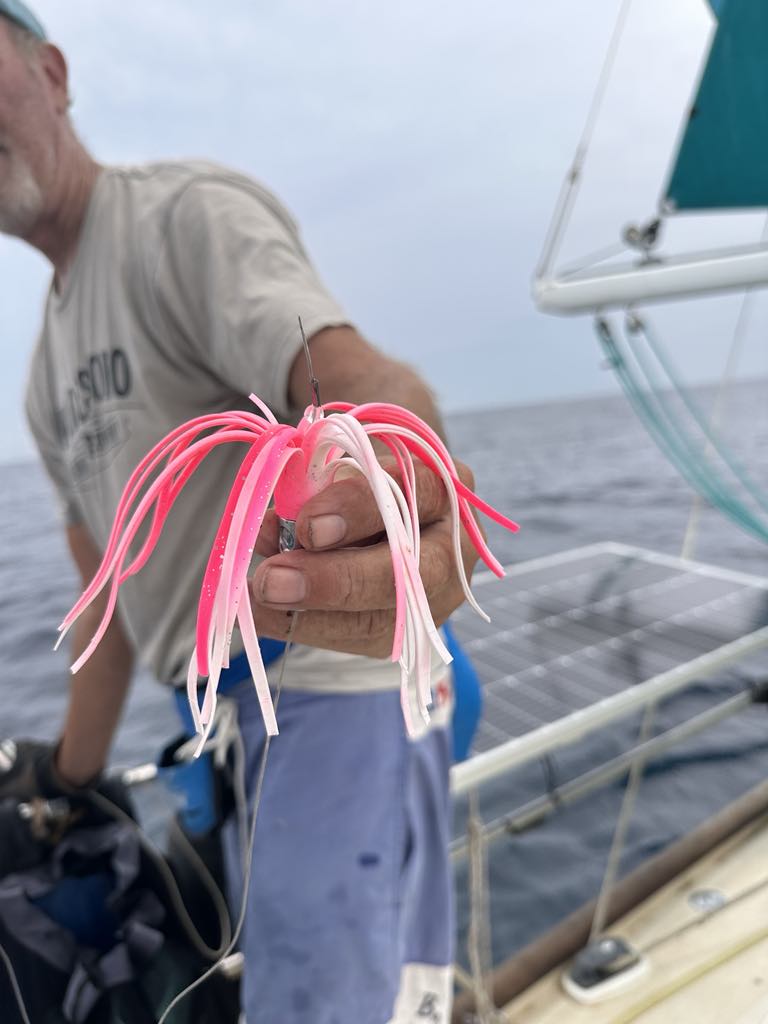
Finally, as Dan reached down as far as he could from the deck toward the fish, I suggested, “Grab his spear! If you can get his beak, you can pull the hook out.”
Dan reached down inches from the spear… then the fish panicked. He immediately took Dan’s presence as a threat and began to thrash. Just like that, the hook snapped, and Dan held our pink squid in his hand.
The fish will be fine; the hook will rust and fall away. Our pink squid needs a new hook, but unfortunately, I am permanently scarred. I haven’t fished since.
Third Time’s a Charm?
Our third attempt seemed to be going well. Dan had replaced a part for our freezer, as it had died; we were all reprovisioned and determined to get across and join all our friends on the other side. As soon as we headed out, the freezer temps started rising. The new part had not fixed the issue. My frozen food days were numbered.
The first week was miserable. We were in the notorious doldrums. It was cloudy, no hint of sunshine for days. The wind was unreliable, unpredictable, and we weren’t going in a good direction. We changed tactics and headed south to get clear of the doldrums and into better weather.
Battle of the Boobies
As we began to get clear of the doldrums, the sun began to appear, and unfortunately, so did the boobies. The boobies are notorious hitchhikers who poop all over your boat. They cover the solar panels with poo; they poop on your dodger (and getting bird poop out of fabric is NOT easy). After finding 10 birds simultaneously perched on our boat, we decided it was time to go to war. Dan got out the airhorn and began blasting it toward the birds. They didn’t panic, but they didn’t like the noise, so they mostly left.
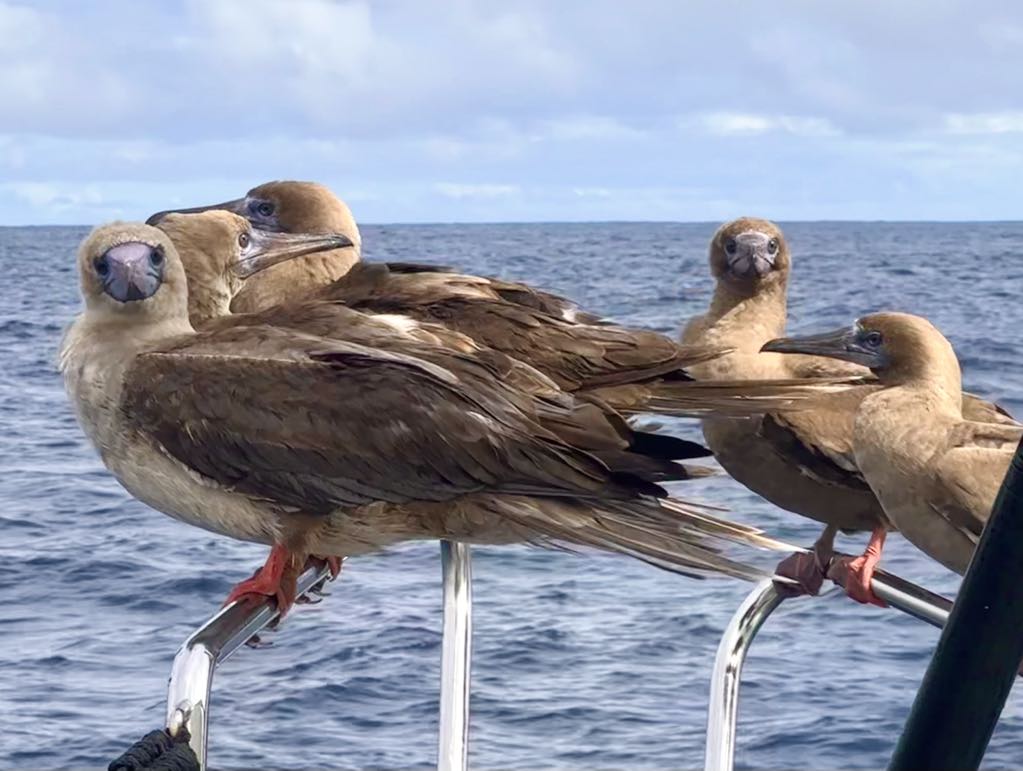
However, boobies are nothing if not persistent. We spent the next three days on booby watch. The moment they started flying above, looking for a landing spot, we would scream, yell, flap our arms (the air horn ran out), and deter them from landing. A few would sneak in at night, but finally, the constant stream of birds ended.
However, life was not going to remain peaceful for long. The next crisis reared its ugly head.
Engine Issues Part Two
Apparently, when we had our engine repaired in Panama City, the guys did a thorough job removing, cleaning, and replacing our turbocharger. However, the engine cooler was cleaned too well. It had a buildup that was hiding some cracks. When the cracks were cleaned, it left a place for all the oil to drain out of our engine. No oil, no working engine.
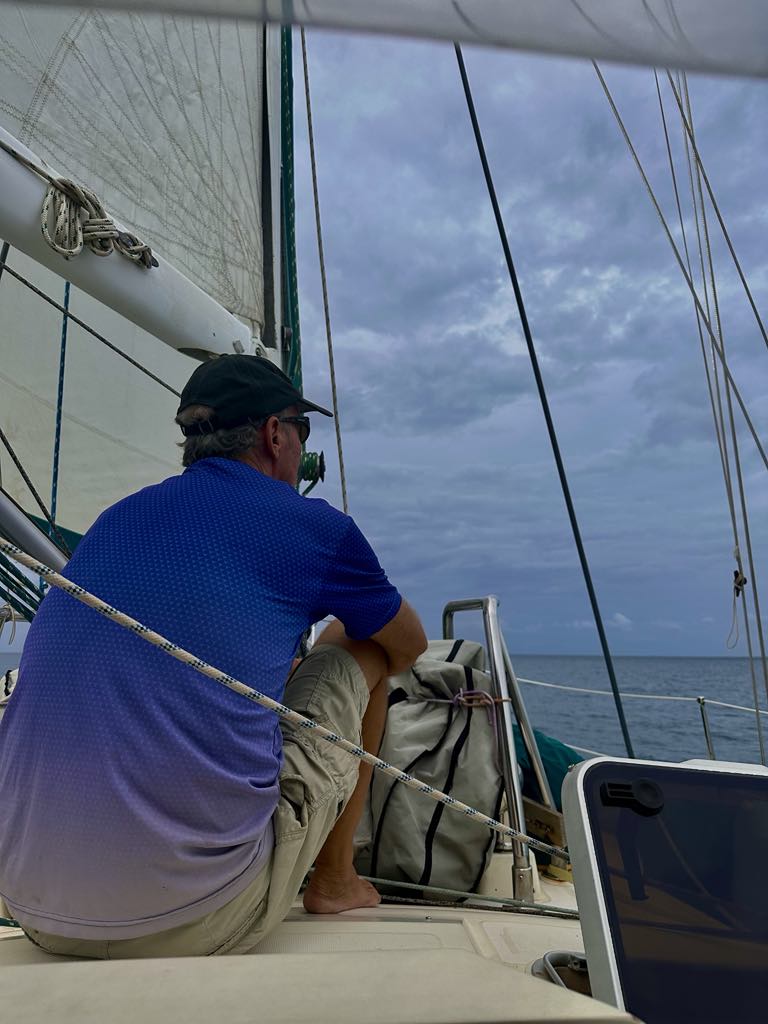
We had been running our engine all night to get us through a lull. Just as we were about to turn it off, it died. There was a bright red Engine Oil light blinking. Sure enough, when Dan checked, all our oil was gone from the engine. We would not be using our engine except in the case of an emergency. He could replace the oil and run the engine for a short time before it leaked out. We prayed we wouldn’t need to use it until we could get across the Pacific and get it repaired.
Of course, there had to be an emergency the very next day.
When Good Jibs Go Bad
Our poor jib. She has been patched and coddled for several years now. I have sewn pieces of her back together on several occasions. Both our mainsail and jib are old, and we had planned on replacing them in Panama. However, our rigging and new forestay (the metal wire running from the mast to the bow that holds the jib) had to be replaced. The new rigging and forestay were so expensive—$30,000—we would have to wait until next year to order the new sails. We planned on having them delivered to Tahiti.
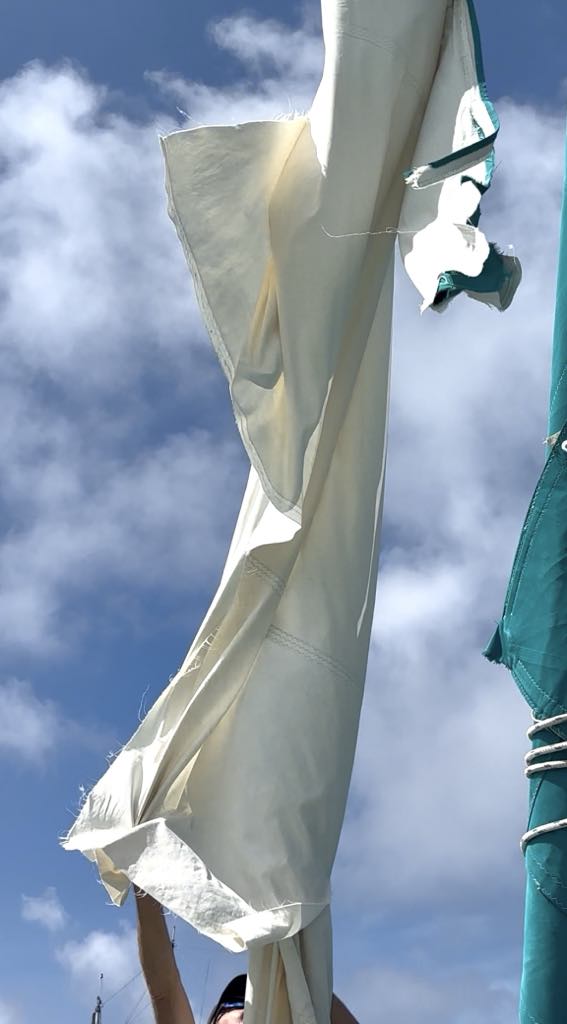
The poor girl did her best, but at 5:00 AM, before the sun was up, we heard a terrible noise coming from the bow. Our sail was in tatters, and she tore apart in the stiff breeze.
There are times when you just want to give up on life. I reached that point… but thankfully, Dan is a lot stronger than I am. I’m a lot like that old jib; he patches me, coddles me, and keeps me from ripping apart. The problem is, unlike the jib, he can’t order a new one of me.
A Much-Needed Break
The theme of our sailing career has been that we have been exactly where we need to be… when we need to be there. I don’t know why I can’t internalize and trust this process. It has held true consistently. I’m working on that issue.
We were headed directly for the Galapagos Islands. We were going to stop in a harbor on the outskirts for one night—surreptitiously, just to say we had been there. Our plan was to spend weeks there on our way across. The cost was enormous, $4,000 just to check in. And, you had to have your boat bottom pristine. One shell on your boat, and you would be turned away, no refund. You had to have your boat fumigated and a certificate for that fumigation. You had to have oil spill kits, special trash containers, and about a dozen other requirements. It was too much for us to contemplate stopping.
It broke our hearts to be passing by one of the destinations we dreamed most about. I’m sure that is why, two days from the Galapagos, our sail and engine gave way. This put us in a great position. We could now enter the Galapagos legally, as a boat in distress. And a boat in distress we were.
Galapagos at Last
There is a guiding force above us that allowed us to enter the islands. Instead of being distraught and having to spend three more weeks at sea with no engine or jib, we are now anchored and legally in the Galapagos. People here have been amazingly helpful and friendly. I was worried about our boat bottom and being expelled after arriving and anchoring at 3:00 AM in the main harbor of Santa Cruz. But with the morning light came a man in a wooden boat who saved the day.
A local man, Pikos, spotted our boat and saw the dirty waterline. He immediately arranged to have our bottom cleaned during the next two hours. We had to have it done before the officials arrived. By early afternoon, we had seven officials on our boat to verify we were a boat in distress and check us into the Galapagos.
It was stressful, as they asked a lot of questions, had a ton of paperwork, and searched our boat, but we passed. And the best part? There were nominal fees compared to the regular entry process.
We now have 20 days to get our issues resolved. There is a person to work on engines, a sail repair person working on repairing our sail, and even a refrigeration person who can hopefully get our freezer working again. There are stores to reprovision before we leave for the three-week crossing to the French Polynesian Islands.
Embracing the Silver Lining
Meanwhile, as the repairs are happening, we can explore, we can go diving, and we can see the islands we have dreamed about for so long, hence my opening quote, a realization I came to embrace:
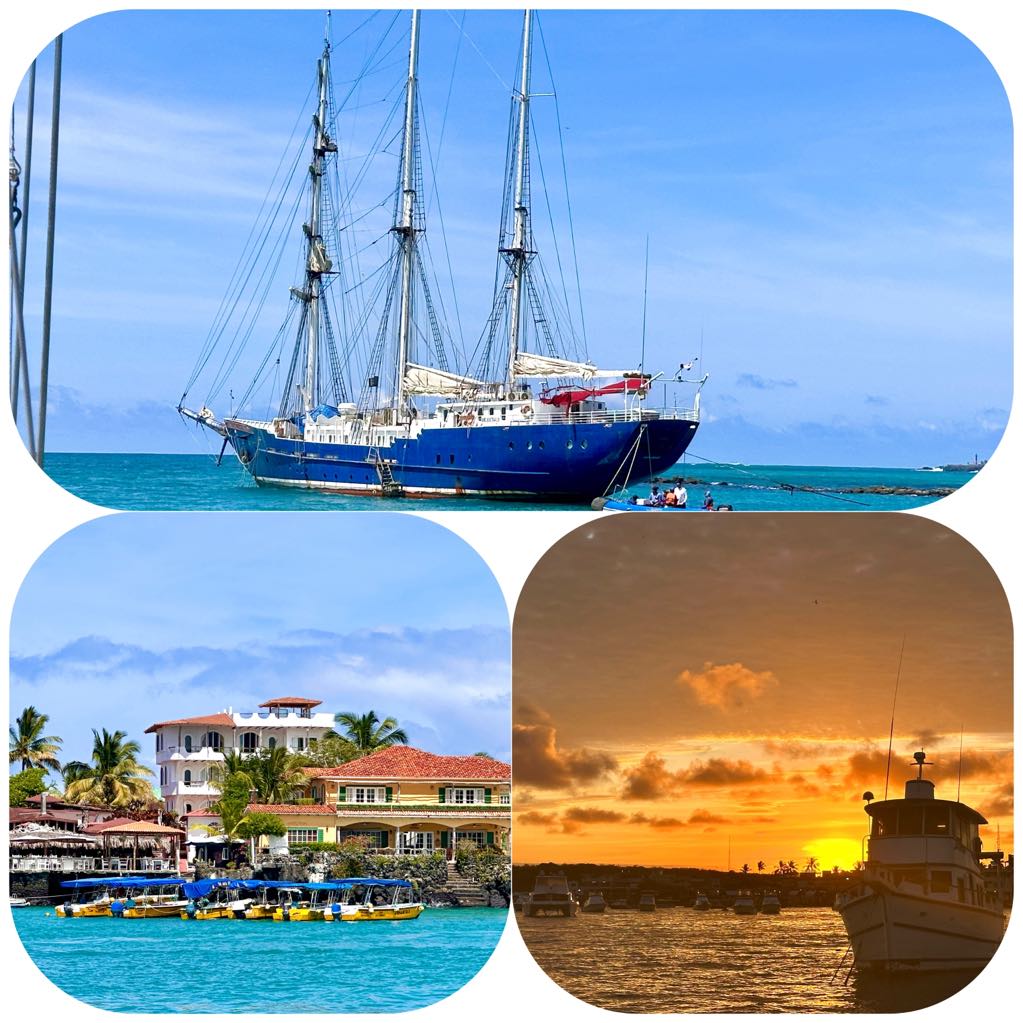
Sometimes, there can be beauty in despair, silver linings in misfortunes, and blue skies in the future where there seems to be nothing but storms.